
Since 1 April 2020, landlords can no longer let or continue to let properties covered by the MEES Regulations if they have an EPC rating below E, unless they have a valid exemption in place. If you are currently planning to let a property with an EPC rating of F or G, you need to improve the property’s rating to E, or register an exemption, before you enter into a new tenancy. If you are currently letting a property with an EPC rating of F or G, and you haven’t already taken action, you must improve the property’s rating to E immediately, or register an exemption. If your property is currently empty, and you are not planning to let it, you don’t need to take any action to improve its rating until you decide to let it again.
It has now become law, throughout Europe, that buildings are assessed for their energy efficiency when they are sold, let or re-let (to new tenants). The final result will be that we know how much energy we are using, how much we are wasting and what we can do to prevent that waste.
Currently EPC’s are valid for 10 Years.
We can also determine from the energy efficiency, what the environmental impact is from each articular building and from this, we can take measures to reduce our carbon emissions and thus reduce global warming.
We all have a part to play to try to ensure our children and their children have a better future and a greener planet to live on.
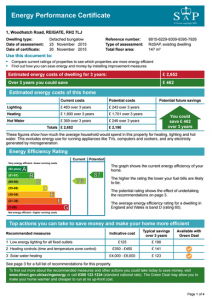
The Energy Performance Certificate (EPC) is a report which details the energy efficiency of your property at the time of assessment and recommends how this can be improved through a series of measures.
We look at a wide variety of factors including:
 The age and construction of the property
- The roof and walls
- The insulation in the property
- The heating and water heating systems
- The lighting systems
- The windows and glazing
On arrival at the property I will:
- Show you an identification card
- Measure all the rooms in the property
- Identify and photograph the heating and hot water systems
- Identify and photograph the building, construction, roof and insulations, including extensions and conservatories, also any habitable outbuildings and rooms in the roof.
- Look in the loft (if you have one) to identify and photograph the insulation.
- Record all of the above information on specifically designed data sheets and then this data is entered into a computer to calculate the energy efficiency.
- On average, the process takes between 30 – 60 minutes (dependent on property size).
What happens next?
Once I have completed the assessment, I will usually have the results by the end of the day of assessment. The report is lodged with the Landmark Registry, a place where all EPC’s are recorded and stored. I will email you a copy of the report or on request I can issue a paper copy of the EPC without an extra charge.
The EPC and Report
The report details what your property’s rating is currently and it looks just like the colour coded panel on your fridge or freezer. It is rated from A to G, where A is the most efficient and G is the least efficient. Further pages of the report detail measures that can be taken to improve the energy efficiency of your property.
Brian Blunden is an accredited Elmhurst Domestic Energy Assessor (EES/002332) working within a 20 miles radius of Crawley, West Sussex.
Brian Blunden is available on 07792 871666, 8am to 8pm, 7 days a week.

